For years, the most common objection in metals sales has been "our buyers aren't ready for digital."
It was a fair objection. It's been a fair objection for a long time.
But it just stopped being one.
The objection wasn't wrong. The premise was.
Operators in metals (service centers, fabricators, distributors) had real reasons to be skeptical of digital sales. Their buyers had real habits, real workflows, real reasons to keep doing things the way they always had.
A purchasing agent at a long-time customer doesn't suddenly want to learn a new portal because you spent six figures on an ecommerce build. A net-new buyer who walked in cold isn't going to start an account just to get a quote. A 30-year veteran who's been emailing RFQs since the fax machine isn't going to log in to a system to check his weekly orders.
So when operators said "our buyers aren't ready," they weren't wrong. They were right.
The mistake was in the premise.
"Going digital" was framed as a single choice
Most digital sales platforms forced operators into a binary: launch a public storefront, or stay analog. Build a portal for your top accounts, or keep emailing them quotes. Add an estimating tool, or keep using spreadsheets.
The platforms made operators pick.
And picking meant choosing which buyer to serve well and which to leave behind.
Pick the public storefront, and your strategic accounts can't see their negotiated pricing. Pick the portal, and net-new buyers bounce off your homepage because they can't browse without an account. Pick the estimating tool, and you're back in email for everything else.
Every digital sales tool had a buyer it served, and a buyer it failed. Most operators were unwilling to make that trade. So they stayed analog. And they were right to.
What changed: buyers don't have to change
The shift isn't that buyers got more digital, though they did. It's that platforms got smarter about how not to force buyers to change.
A buyer who emails RFQs can keep emailing. Our Sales Assist module now reads inbound emails, matches each line to your catalog, and drafts the quote, keeping the same email flow your buyers already trust.
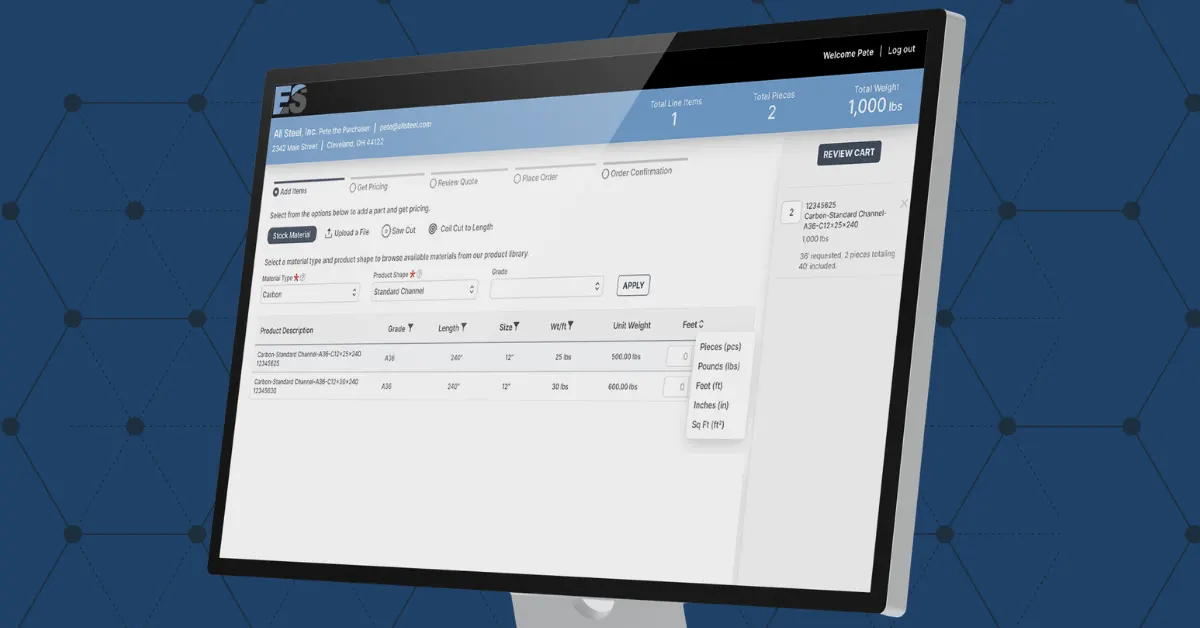
A strategic account who wants their own portal can have their own portal. Customer-specific pricing, contract terms, and order history all show up. They self-serve at 3am if they want to. Plus, they get an opportunity to see what else you offer.
A net-new buyer who finds you on Google can buy from you right then. A modern storefront lets them transact directly. Cash in advance keeps the risk off of you. They don't have to create an account, set up payment terms, or wait for credit approval. If they want to keep buying from you, they can become a portal customer later.
These three buyer behaviors don't happen in one workflow. They happen in three. The shift in metals digital sales is that those three workflows can finally live in one platform.
You serve all three. You always have.
Here's the part that takes people a minute to see: every metals seller already has all three buyer types.
You've got Mike, who emails RFQs at 4pm on Friday and wants the quote by Monday morning.
You've got Acme Manufacturing, on the books for 12 years, with negotiated pricing on 47 SKUs and a purchasing manager who reorders the same six items every Wednesday.
And you've got the new fabrication shop in Kentucky who found you on a search for laser-cut HR plate, has never spoken to anyone at your company, and wants to buy three sheets without setting up an account or filling out a credit application.
You've always served all three. Mike got an email reply. Acme got a phone call. The Kentucky shop got told to "have your purchasing manager reach out so we can set up an account" and went somewhere else.
The "we don't sell online" objection wasn't really about going online. It was about not wanting to fail the first two buyers in service of the third.
You don't have to.
A different sales conversation
What changes when an operator can serve all three buyer types from one platform?
A few things, but the biggest one is the sales conversation. Both directions.
When we sell to you, the conversation stops being "can we modernize?" and starts being "which of your buyers do you want to grow with and how?" Wallet share with strategic accounts. Capacity for your sales team to handle inbound RFQ volume without adding headcount. A net-new buyer pipeline that doesn't require an outbound rep. You can pick more than one.
When you sell to your customers, the conversation stops being "you have to use our system" and starts being "use whatever works for you." That's a different relationship. It's also a different reorder rate.
The objection didn't get answered. It dissolved.
The metals sellers who said "our buyers aren't ready for digital" weren't wrong. They were right, until they weren't.
The platforms got smarter. The buyer didn't have to.
So the next time you hear yourself say "our buyers aren't ready," or hear it from someone on your team, it's worth asking: ready for what? Stella isn't asking your buyers to do anything different.
Stella is asking you to stop picking.
Book A Demo today to see what Stella can look like for your business.