Walk through almost any fab shop and you can see where the money went: fiber lasers, press brakes, automation that would have sounded like science fiction twenty years ago. Then walk into the front office, where the next million dollars of work is sitting in an inbox, waiting on one estimator, a part file, and a calculator.
Shops tell us the same thing every week: “We can’t quote fast enough. By the time we respond, the customer has already gone somewhere else.”
Here’s the good news: quoting speed is the most fixable problem in your building. The fix isn’t working nights or hiring another estimator; it’s moving quoting online and letting software do the math. Two changes, specifically:
- Simple jobs quote themselves. A customer uploads a part file to your online storefront and gets a price instantly, day or night; no estimator is involved. (In Stella terms, that’s Fabrication Sales.)
- Complex jobs get quoted from the geometry. Software reads the part file, nests it, and calculates machine time, so your estimator reviews a quote in minutes instead of building one for hours. (That’s Advanced Quoting.)
Simple work self-serves and complex work quotes from geometry. Before we get into the guide, let’s put a number on what the current process is costing you.
What slow quoting actually costs you
Slow quoting never feels like a crisis, because the cost is invisible. Nobody logs the jobs you never had a chance to win. But the tab is running, and it compounds.
You lose jobs you should have won. In fabrication, the fastest quote usually wins. Being first to respond can boost your chances of winning the business by 50%. Read that again. Half your losses might not be about price, capability, or quality. Just speed.
You leave margin on the table. Speed doesn’t just win jobs; it wins better jobs. Shops that respond first could quote higher and still win the work. Respond three days late and you’re competing on price. Respond first and you’re competing on responsiveness, and buyers pay for that.
Your estimator is your revenue ceiling. If quoting takes hours per job, your shop can only sell as fast as one person can calculate. Meaning more RFQs don’t always mean more revenue — they mean a longer backlog. Growth stalls in the front office while the floor sits ready for more.
Your quoting knowledge can walk out the door. When pricing logic lives in one estimator’s head, their retirement notice is also your quoting department’s. Every year that knowledge stays undocumented, the risk grows.
After-hours RFQs sit until Monday. A customer who uploads a part file at 5pm Friday wants an answer, not a voicemail. 51% of buyers will choose suppliers with an online store, and online-first shops are quoting your customers at midnight while their RFQ to you waits in an inbox.
Your biggest customers are raising the bar. OEMs are consolidating supplier lists, and quoting turnaround is one of the criteria. Shops that can’t respond digitally and quickly are getting cut quietly, without a phone call to explain why.
Manual vs. geometry-based estimating: why the math is so slow
Nearly all of that cost traces back to one root cause: the estimate is built by hand instead of read from the part file.
Manual estimating means opening the drawing, doing a takeoff, guessing at material yield, calculating machine time from memory or a spreadsheet, and adding operations line by line. It works — slowly. And it can give you different answers depending on who’s estimating and how their Tuesday is going.
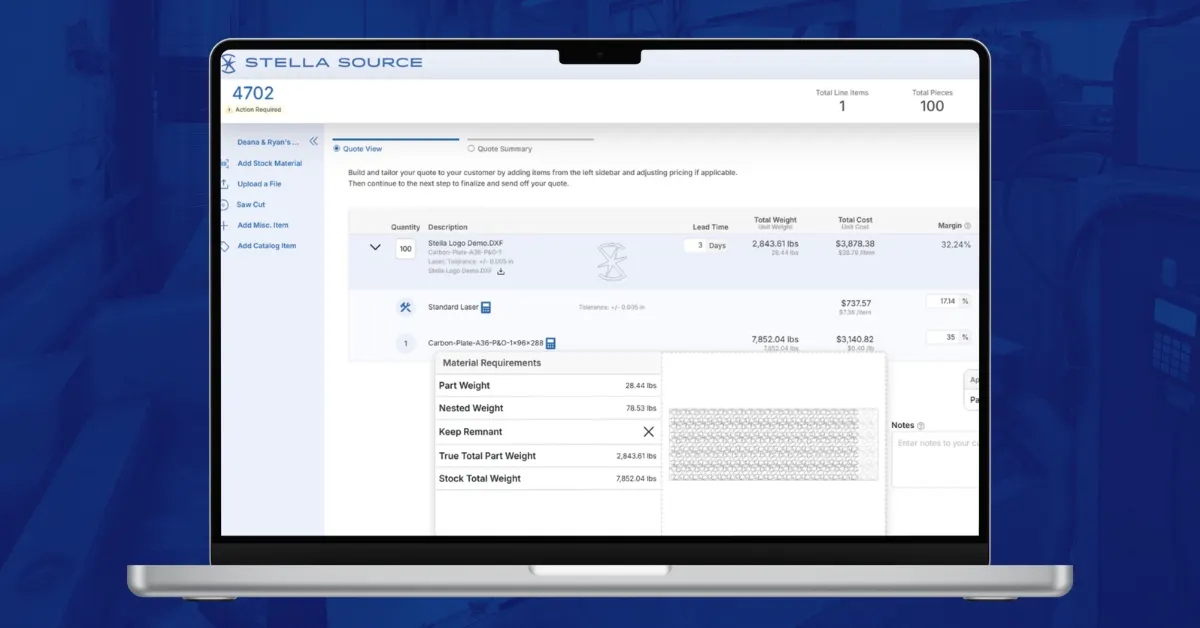
Geometry-based estimating flips it: the software reads the part file directly. It measures the actual geometry, nests parts to determine true material requirements, pulls machine run times from tables tuned to your equipment, and applies your costing rules automatically. Your estimator reviews and adjusts instead of building from scratch.
| Manual estimating | Geometry-based estimating | |
|---|---|---|
| Starting point | Drawing + takeoff by hand | The part file itself (DXF, DWG, STEP, and more) |
| Material calculation | Estimated yield, rules of thumb | True-shape nesting (actual geometry on actual stock) |
| Machine time | From memory or spreadsheet | Calculated from tech tables that mirror your real run rates |
| Consistency | Varies by estimator | Same inputs, same answer, every time |
| Who can quote | Your most experienced estimator | Any team member, not just the expert |
| Time per complex quote | Hours to days | Minutes |
The difference isn’t subtle. For shops quoting complex assemblies, processes that took half a day or more can get slashed to 30 minutes or less.
So that’s the destination: simple jobs self-serve online while complex jobs quote from geometry in minutes. The obvious question is how you get there from a shop that quotes everything by hand today. That’s the rest of this guide: eight steps, roughly in the order shops actually make the change. You don’t need all eight on day one. Most shops start with two or three and build from there.
How to quote sheet metal fabrication jobs faster: 8 steps
1. Capture every RFQ in one workflow
Before you can quote faster, you have to see everything you’re quoting. RFQs arrive by email, phone, referral, and walk-in, and every channel is a place for jobs to quietly die. Route everything into a single quoting workflow with visibility into what’s pending, what’s in progress, and what’s aging. An RFQ nobody’s tracking is a job you’ve already lost — you just don’t know it yet.
2. Split the lanes: simple jobs self-serve, complex jobs get the expert
Here’s where the two lanes from the top of this guide become real. A standard profile-cut job and a 40-part welded assembly should not wait in the same queue behind the same estimator. Put a self-serve storefront in front of the simple work: the customer uploads a part file, gets an instant price, and orders, while your estimator never looks up. That one change removes the high-volume, low-complexity work that eats estimating time disproportionately, and clears the queue for the jobs that actually need an expert.
3. Quote from the part file, not a takeoff
Your customers are already sending DXF, DWG, and STEP files. Quote directly from them. Geometry tools that clean imperfect files, unfold 3D models to flat patterns, and auto-detect bends and welds eliminate the takeoff step entirely — and the transcription errors that ride along with it.
4. Nest for estimating accuracy, not production
Material is usually the biggest line on the quote, which makes material errors the biggest margin killers. True-shape nesting places actual part geometry on actual stock sizes, so you quote the material the job really needs — not a percentage guess. Underestimate and you eat the difference; overestimate and you lose the job. Accurate nests protect you from both.
5. Standardize the work you quote repeatedly
Most shops quote the same kinds of parts, operations, and material combinations again and again, and rebuild the estimate from zero every time. Package the frequent combinations into reusable configurations and kits. Repeat work should take minutes, and it should price identically no matter who quotes it.
6. Automate costing rules and material pricing
Every manual lookup is a delay hiding in your process. Costing rules for operations, labor, and special pricing should fire automatically. Material prices should come from real-time supplier pricing, not a phone call to check today’s number. When the inputs are current and automatic, the quote is fast and defensible.
7. Let more people quote
If only one person can produce an accurate quote, your quoting speed is capped by one calendar. Standardized workflows change that.
“SecturaFAB [Advanced Quoting] takes a highly skilled task and reduces it to a task that others can confidently take on.”
Dallas McInnes, Sales Manager
When trained team members can quote confidently, your expert stops being the bottleneck and starts being the reviewer.
8. Close the loop online
The quote isn’t the finish line — the order is. Every quote should be acceptable, orderable, and payable online, so a yes at 9pm becomes an order at 9:01 instead of a Monday phone call. Quote-to-cash in one system also means nothing gets re-keyed and nothing gets lost between the quote and the invoice.
Where Fabrication Sales and Advanced Quoting fit
You’ve already met both halves of this system — they’re the two lanes we started with. In Stella Source, they have names:
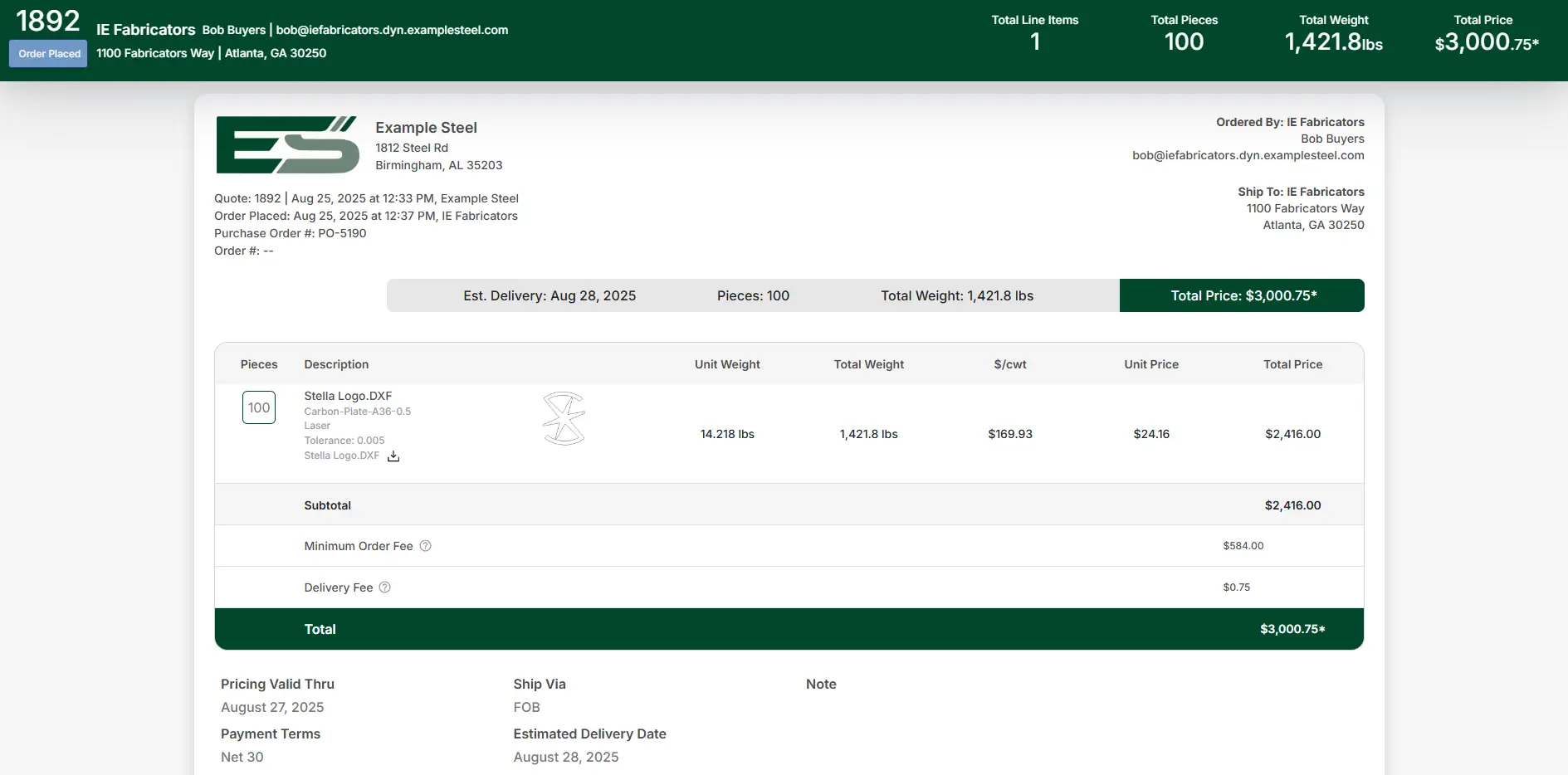
Fabrication Sales is the self-serve lane (steps 1, 2, and 8): customers upload part files to your branded storefront and get instant quotes on routine cut and fab work, then accept, order, and pay online, around the clock.
Advanced Quoting is the complex lane (steps 3 through 8): a geometry-based estimating engine, built fabrication-first, with true-shape nesting tuned for estimating accuracy and support for 30+ machine types. It reads the files your customers already send (DXF, DWG, STEP, IGES, SolidWorks, NC1, even PDFs and images), cleans and unfolds geometry, recognizes bends and welds, and applies your costing rules and real-time material pricing automatically.
Together they cover every job type: volume on the simple end, precision on the complex end, one platform from quote to order to payment. And the results shops report aren’t incremental:
- 89% reduction in quote creation time for complex assemblies
- Up to a 400% increase in total quote volume
“SecturaFAB [Advanced Quoting] turned a two-day project into literally a two-hour project. We were probably doing two projects a day before, now we can easily do 10.”
Rachelle Shapley, Sales Associate
“A process that took half a day or more is slashed to 30 minutes or less.”
Stacey Hertzog, VP of Operations
“Our quote throughput has increased by 50%, which allows us to better serve our customers by putting more time back into the hands of our sales team.”
Dustin James, Sales Manager
And no, setup isn’t an IT project. Advanced Quoting is configured to your machines during onboarding by a dedicated team, most shops are live in weeks, and your first 60 days are free. See fabricator pricing for what each plan includes.
Frequently asked questions
How long does it take to quote a sheet metal fabrication job?
Manually, a complex fabrication quote takes hours to days with one estimator working through takeoffs, material calculations, and machine times by hand. With geometry-based estimating, shops quoting complex assemblies report that processes that took half a day or more are slashed to 30 minutes or less.
What is geometry-based estimating?
Geometry-based estimating is quoting software that reads the customer’s part file directly, measuring the actual part geometry to calculate material requirements, machine run times, and operations automatically. The result is faster quotes with consistent, defensible pricing.
What file formats can be quoted from?
Advanced Quoting reads DXF, DWG, STEP, IGES, SolidWorks (SLDPRT/SLDASM), NC1, vector and raster PDF, and common image files like JPG and PNG, so you can quote from virtually any file a customer sends. Fabrication Sales accepts DXF, DWG, and STEP.
What is true-shape nesting, and why does it matter for estimating?
True-shape nesting lays out actual part geometry on actual stock material to calculate the real material required for a job. It matters because material is usually the largest cost on a fabrication quote. Nesting tuned for estimating accuracy means you neither underquote (and eat the difference) nor overquote (and lose the job).
Can someone who isn’t an expert estimator produce an accurate quote?
Yes. With standardized workflows, costing rules, and machine calculators doing the math, trained team members can produce accurate, consistent quotes without years of estimating experience. That removes the single-estimator bottleneck that caps most shops’ quoting capacity.
How fast can quoting software be up and running?
With Advanced Quoting, most shops are live in weeks. It’s configured to your machines, tech tables, and nesting parameters during onboarding by a dedicated team. With Fabrication Sales, you can be up and running in 14 days or less, with a fully branded online storefront ready to accept quotes and turn them into orders in minutes.
Quote your next complex job in minutes, not days
The shops winning more work in 2026 aren’t quoting harder, they’re quoting differently. Simple jobs self-serve online. Complex jobs quote from geometry. And the first quote in the customer’s inbox is theirs, while everyone else is still doing takeoffs.
Book a demo to see how Advanced Quoting and Fabrication Sales work on your machines and part files.